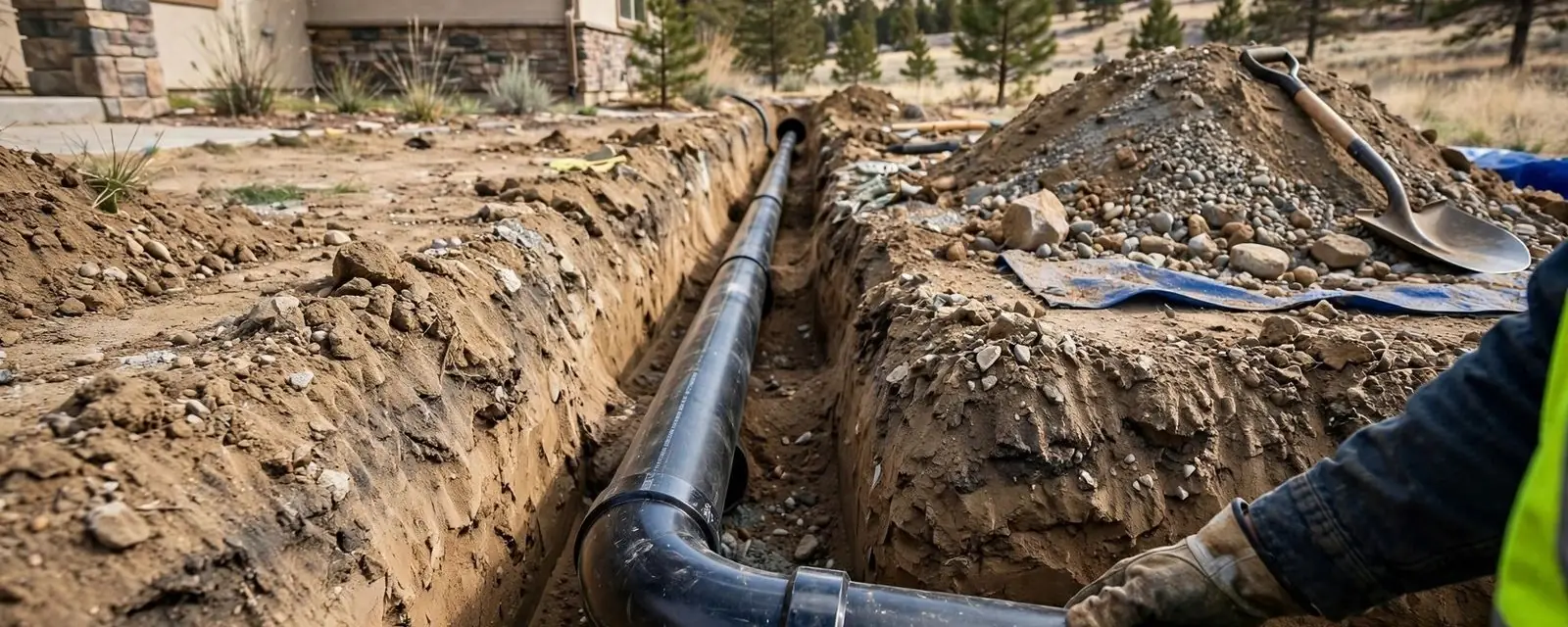
Sewer backup emergency: what to do first
Sewage in a tub, floor drain or toilet is not like clear water. It carries bacteria and should not be handled without gloves and boots. Treat the first hour as damage control:
- Stop running water everywhere, including the washer, dishwasher and showers
- Keep children, pets and anyone with a weak immune system out of the area
- Do not use a plunger or chemicals on a main line backup
- Photograph the damage for insurance and take the call to the 24/7 line
Cleanup of sewage-contaminated materials is often best left to a restoration company. The plumber's job is to restore the flow and find the cause. The sewer line cleaning page covers the clearing step.
Signs the sewer line itself has failed
A one-time clog clears with cleaning. A failed line keeps returning. Slow drains in several fixtures, gurgling toilets, sewage smell in the yard, soft or sunken ground over the line and repeated roots in the cleanout all point at a damaged pipe. In older houses the problem is often a joint, not a long run.
A camera tells the story. A plumber feeds a small camera through a cleanout and records the pipe condition, showing cracks, offset joints, bellies and root entry. See our sewer camera inspection service to learn what to expect and what to ask for in the written findings.
Cast iron, clay and Orangeburg: what Winchester's older lines look like
Houses built before the mid 1900s commonly used cast iron inside and clay tile outside to the street. Mid-century homes sometimes used Orangeburg, a tar-impregnated fiber pipe that deforms and collapses with age. Newer lines are PVC. Winchester has all of those eras, from Greek Revival homes near the center to post-war houses on the West Side.
Each material fails differently. Cast iron scales and cracks, clay breaks at the joints and admits roots, and Orangeburg ovalizes. Knowing what you have changes the repair. If the camera shows your house line is an old iron stack, small cracks can often be sleeved. If it is collapsed Orangeburg, replacement is likely.
Repair options compared
| Method | What it is | Good for | Limits |
|---|---|---|---|
| Spot repair | Dig down and replace a short section | One broken joint or crack | Needs excavation at that spot |
| Cast iron sleeve or coupling | Repair a cracked section inside a basement run | Short cracks in accessible iron | Not for long runs of rot |
| Pipe lining (CIPP) | Resin lined tube cured inside the old pipe | Cracks and root entry along a run | Needs a clean pipe and a fairly straight path |
| Pipe bursting | New pipe pulled in as the old one breaks apart | Fully failed runs | Needs access pits at both ends |
| Full replacement | Trench out the old line and install new | Collapsed or badly bellied lines | Most disruptive and costly |
Trenchless methods avoid tearing up the lawn and driveway, which matters in a town with established landscaping and tight lots. They are not always possible. The plumber should tell you why one method fits your pipe and not another, and show the camera footage that supports it.
Roots, bellies and offset joints
Roots are the most common reason a sewer line needs more than cleaning. Fine roots enter through a tiny gap and grow into a mass. A belly is a low spot where the pipe has sagged. Water and paper settle there and form repeat clogs. An offset joint creates a lip that catches debris. Each calls for a different repair, so the diagnosis matters.
Septic: if your property is on a septic system and not a town sewer connection, tell the dispatcher at the start of the call. The equipment and the repair approach are different, and your description saves a second visit.
What affects sewer line repair cost
This is the most variable cost in residential plumbing. Quotes depend on:
Most homeowner policies exclude the sewer pipe repair itself, and some cover resulting damage only with a sewer backup endorsement. Ask before you need it. Want your real number? Call (339) 216-9771 and the price is agreed before work starts.
Sewage backing up?
Stop water use and call the 24/7 line now.
Permits, town connections and who owns what
Sewer repair that connects to the town system can involve the Winchester Department of Public Works as well as the Building Department. Ask the plumber who pulls the permit and whether any street opening is needed. Homeowners are generally responsible for the lateral from the house to the connection, but the exact boundary is something to confirm with the town before you dig. Homeowners in the Woburn service area face the same question about where the town's responsibility ends.
In Massachusetts, the state plumbing code at 248 CMR 10.00 sets the rules for installation and repair, and licensing comes from the Board of State Examiners of Plumbers and Gas Fitters. Permit rules vary by job, so ask the Winchester Building Department or your plumber what applies to yours.
Written by the Winchester Pro Plumbing team.
Sewer Line Repair questions in Winchester
If cleaning holds for months, the line is likely sound. If clogs return quickly or a camera shows cracks, roots or sags, repair is the real fix.
It is for many cracked or rooted lines that are otherwise straight. It is not suited for collapsed pipe. The camera footage decides.
Yes. Sewer backups are health hazards, so dispatch is open around the clock. Same-day appointments are offered when available. Tell the dispatcher where the sewage is appearing and stop all water use until the plumber confirms the line is clear.
A spot repair can be done in a day. Lining and trenchless methods take a day or two. A full replacement takes longer. The plumber gives a time window after inspection.
Most policies do not cover the pipe itself. Some cover resulting damage with a backup endorsement. Call your agent and ask directly.
Often yes. Short cracks or failed joints in accessible cast iron can be fixed with a sleeve or a no-hub coupling. Long runs of corroded iron may be better replaced.