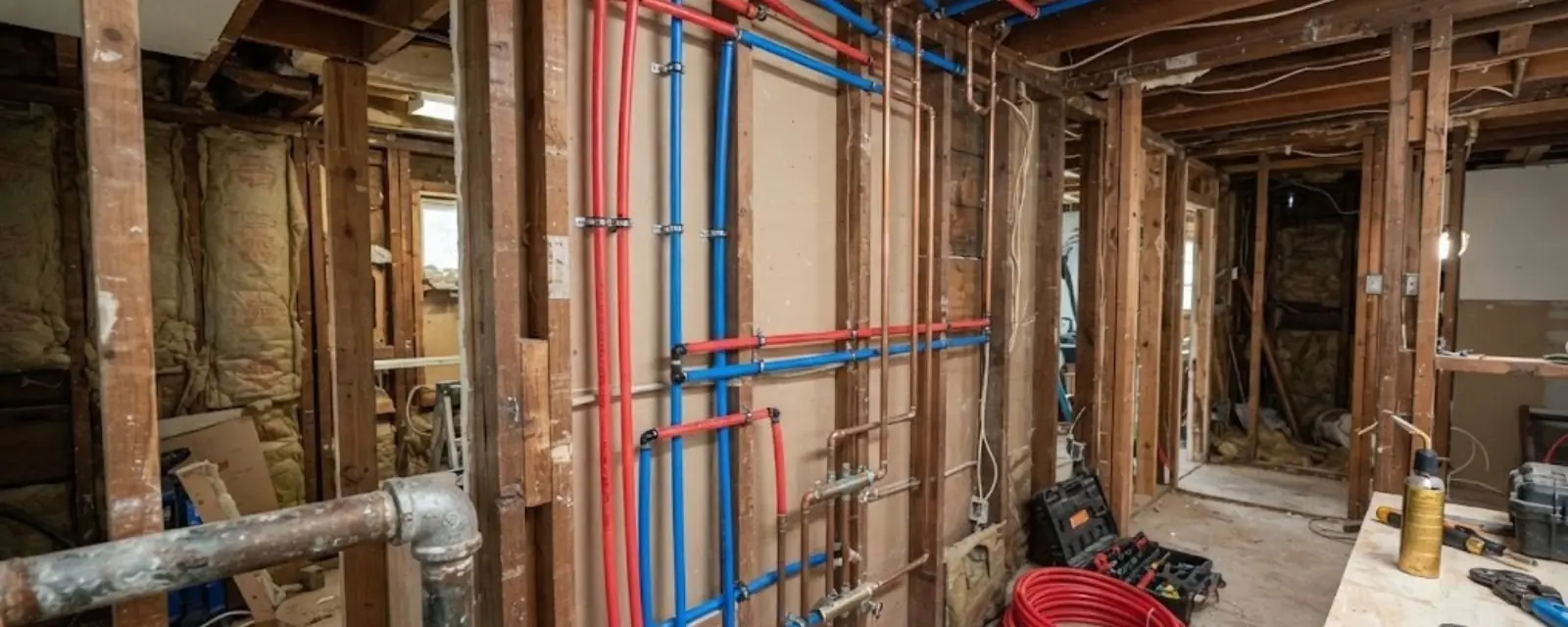
When repairs stop making sense
One leak is a repair. A pattern is a signal. If you have patched the same system several times in a few years, the next failure is probably close. Pipes fail from the inside, so the section you see is rarely the only weak spot.
- Brown or rust-colored water when you first open the hot tap
- Low pressure at fixtures that has been getting worse for years
- Pinhole leaks in copper, or green staining on fittings
- Galvanized steel supply lines in an older house
- A history of burst pipes in the same walls
For an active leak see burst pipe repair. When repair after repair has not held, repiping stops the cycle.
What Winchester's house eras mean for your pipes
Winchester's homes were built in waves. The mid 1800s Greek Revival and Italianate houses near the center, the Queen Anne and Shingle houses in Firth and Wildwood from the 1870s on and the Wedgemere houses from roughly 1890 to 1920 all predate modern plumbing. Many have been updated, but updates are often partial, with old and new pipe mixed in the same walls.
Galvanized steel was a common supply material for decades and it rusts from the inside, narrowing the bore and shedding rust. Copper has a long life but pinholes in aggressive water or from flux and installation faults. Post-war houses on the West Side more often have copper, and later houses PEX. Knowing your era points to what may be inside the walls.
PEX or copper: how to choose
| Material | Strengths | Trade-offs |
|---|---|---|
| PEX | Flexible, fewer fittings, quicker to run through walls, resists freeze splitting better than rigid pipe | Not for outdoor sun exposure, needs proper support |
| Copper | Long record, tolerates heat, familiar to inspectors | Higher material and labor cost, joints need soldering |
| CPVC | Low cost, corrosion resistant | Brittle with age, less common for whole-house work now |
Both PEX and copper have good records when installed properly. The plumber should explain why one fits your house, with attention to access, budget, water chemistry and resale. Ask which fittings are used and where the manifold or main lines will be placed.
How a repipe is done in an occupied house
A repipe is a planned project that can often be finished in a few days, depending on the size of the house. The plumber opens small access holes in walls, runs new lines through existing chases where possible and connects each fixture. Water is shut off during parts of each day, and the plumber should tell you the plan in advance.
Drywall repair and paint are separate trades. Ask whether patching is in the price or not. In plaster-and-lath homes common in older Winchester houses, access cuts need special care, and some owners choose to schedule repiping alongside a kitchen or bath remodel to share the wall opening.
Partial repipe or whole house?
Sometimes a partial repipe is the sensible step. If only the kitchen and bath on one side have failed galvanized pipe, you might replace just that branch. But partial work leaves old pipe connected to new, and mixing metals can cause corrosion at the joint. Ask the plumber to explain the joint and the remaining life of the unreplaced sections.
Also ask about the main shutoff and the service connection. A new set of pipes behind a bad main valve is a missed chance. The water service line page covers the line from the street.
What affects repiping cost
Repiping is a large project priced by house, not by the foot alone. The factors:
Insurance generally does not pay to replace aging pipes before they fail. It may cover damage from a sudden burst afterward. Keep the plumber's findings for any claim. Want your real number? Call (339) 216-9771 and the price is agreed before work starts.
Thinking about repiping?
Call (339) 216-9771 to talk to a licensed plumber about your house.
Permits and inspection
Replacing piping requires a permit in Massachusetts, according to state consumer guidance for plumbers. The plumber pulls it through the local inspector and the work is inspected before walls are closed. Do not hire anyone who skips the inspection. You can check a plumber's license through the state board by phone or its online portal. Repipe consultations are also offered in Lexington.
Plumbing work in Massachusetts falls under the state plumbing code, 248 CMR 10.00, and plumbers are licensed through the Massachusetts Board of State Examiners of Plumbers and Gas Fitters. Ask any plumber to confirm their license and which permit the job needs before work starts.
Written by the Winchester Pro Plumbing team.
Repiping questions in Winchester
Galvanized pipe is gray steel with threaded fittings. A magnet sticks to it, and a scratch shows silver. Rust at joints and brown water are common clues.
Often two to five days for an average house. Larger houses and plaster walls take longer. The plumber gives a plan based on a site visit.
Usually yes, with scheduled water shutoffs during the day. Ask the plumber for a daily plan so you can prepare.
If the cause is narrowed galvanized or corroded pipe, yes, often noticeably. If the cause is the service line or a regulator, those need attention too.
It depends on the market and the pipe. Buyers and inspectors often react to galvanized or failing pipe, so documentation and a clear plan can matter.