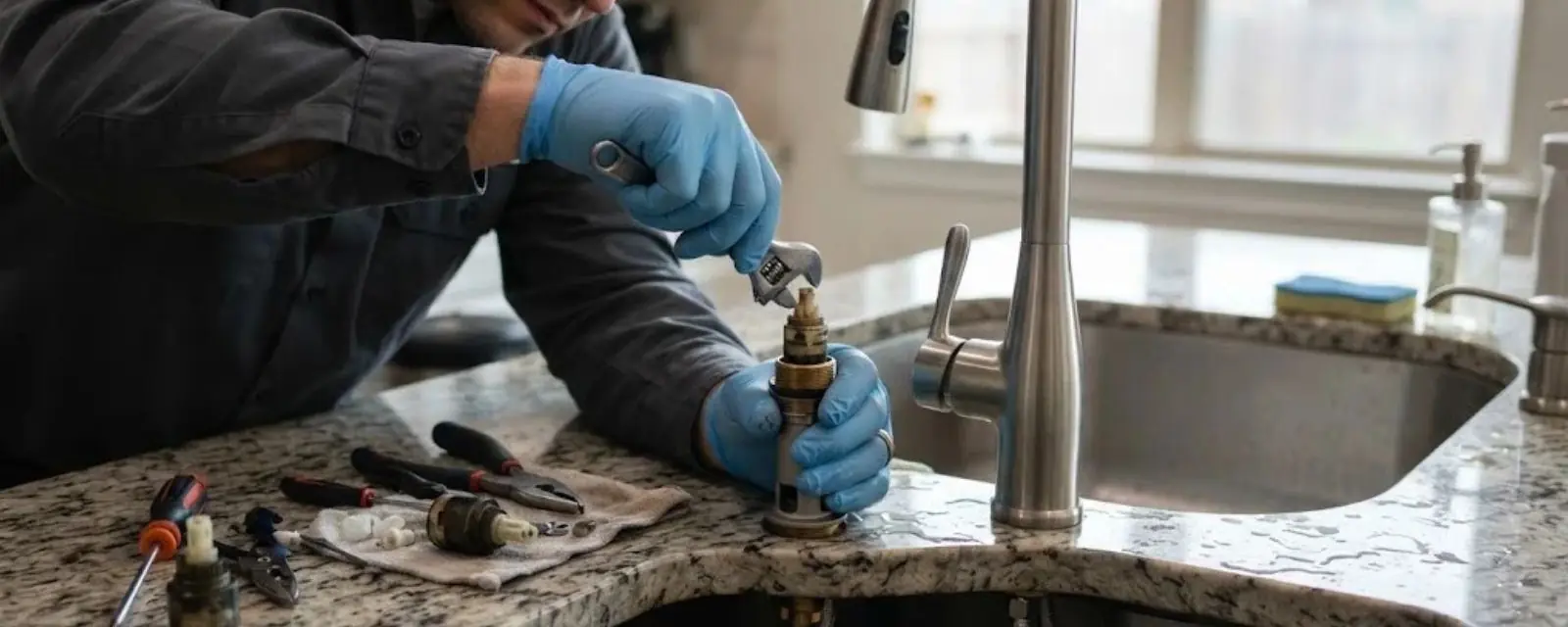
Where is the leak coming from?
| Where it leaks | Probable cause | Usual fix |
|---|---|---|
| Drips from the spout when off | Worn cartridge or seats and springs | Replace cartridge or seats |
| Water at the base of the handle | Worn cartridge O-ring | Replace the O-rings or the cartridge |
| Water around the base of the spout | Worn spout O-rings | Replace the spout O-rings |
| Water under the sink | Supply line, connection or faucet body crack | Tighten or replace, check body |
| Handle stiff or loose | Mineral buildup, loose set screw | Clean and tighten |
A drip at the spout is the classic sign of a worn internal part. A leak at the base means the O-rings that seal the moving parts have hardened. Water under the cabinet is a different category. It could be a supply line or the faucet body, and it is worth fixing quickly to protect the cabinet.
Identify your faucet type
Single-handle faucets use one of three internal designs. A cartridge faucet has a metal or plastic insert that slides up and down and rotates. A ball faucet has a rotating ball with rubber seats. A ceramic disc faucet has two ceramic plates that seal against each other. The repair parts differ, so identify yours before buying anything.
Look under the handle for a brand name or model number and photograph the faucet. Take the old cartridge to the supplier to match it. Many cartridges look similar but have different stem lengths or splines. A mismatch causes a new leak.
Cartridge repair, step by step
- Close the shutoff valves under the sink, then open the faucet to drain pressure
- Pry off the cap on the handle and remove the screw underneath
- Lift off the handle and remove the retaining nut or clip
- Pull the cartridge straight up, noting how it is oriented
- Install the new cartridge, match the orientation and replace the O-rings
- Reassemble, open the shutoffs slowly and check for leaks
Put a towel in the sink to catch dropped parts and cover the drain. Do not force a stuck cartridge. A puller tool or a penetrating oil helps. If it will not come out, stop and call. A broken cartridge can damage the body and turn a small repair into a replacement. The faucet repair page explains what a plumber does.
Faucet still leaking after you tried?
Call (339) 216-9771 and a licensed plumber can take over.
Repair or replace?
If the faucet is under about fifteen years old and the body is sound, repair costs little. If the finish is peeling, the body is corroded or parts are no longer made, replace the faucet. Replacing is also a chance to upgrade to a pull-down sprayer or a better aerator. Ask the plumber to replace the supply lines and check the shutoffs at the same visit. The same repair is available in Medford, MA and Arlington.
Kitchen faucet upgrades often go along with a new sink or a disposal. If that is the plan, garbage disposal installation covers the connections. And if water has already stained the cabinet or the ceiling below, consider leak detection to rule out a hidden source.
Shutoff valves: the other half of the repair
A faucet repair assumes you can shut off the water. Old stop valves under sinks seize or leak when turned. If yours does not close fully, do not force it. Close the main for the house and have the plumber replace the stop with a quarter-turn valve. It is a small job that saves a lot of grief later.
Parts and tools checklist
- A set of hex keys, a small flat screwdriver and an adjustable wrench
- Replacement cartridge or O-ring kit that matches your faucet
- Plumber's grease for the O-rings
- A cartridge puller if the cartridge is stuck
- A towel and a small container for screws
- White vinegar for cleaning mineral buildup
Before you start, look at the aerator at the end of the spout. A clogged aerator can make a faucet seem to leak or spray sideways. Unscrew it, rinse out the screen and soak it in vinegar for an hour if there is buildup. It takes five minutes and sometimes solves what looked like a bigger problem.
Grease the O-rings lightly with plumber's grease when you reassemble. It lets the handle move smoothly and helps the seals last. Open the shutoff valves slowly, check for drips for a few minutes and run the faucet through its full range.
Know when a repair is not worth it. If the faucet is decades old, the finish is pitted and replacement cartridges are hard to find, a new faucet may be a better use of an afternoon than a fourth repair. If the leak comes from the base of the faucet or from the supply lines under the sink, the cartridge is not the cause, and swapping it will not help.
Watch where the water appears before you take anything apart. A dry paper towel held under each joint shows the source quickly. If you cannot find it or a shutoff valve will not close, stop and call a plumber instead of forcing it.
Winchester notes: permits, water and older fixtures
State consumer guidance says minor repairs such as fixing a leaky faucet do not need a permit, while replacing or relocating fixtures, valves or piping does. Repairing a cartridge is minor. Replacing the faucet and shutoff valves may fall on the other side, so ask the Winchester Building Department or your plumber.
Winchester homes range from mid 1800s houses to post-war neighborhoods, and fixtures in older homes may be decades old. Parts for discontinued faucets can be hard to find. If you cannot identify the faucet, replacement is often the practical choice.
Mineral buildup can stiffen handles and clog aerators. We found no hardness figure for Winchester in the MWRA community report, so test your tap and ask the Winchester Water Department for its latest report. Soaking an aerator in vinegar clears light buildup.
Single-Handle Faucet Repair: local questions
Take the old cartridge to a plumbing supplier, or find the brand and model on the faucet. Match the stem length and splines exactly.
Worn O-rings on the spout are the usual cause. They are cheap to replace.
No, unless it will not shut off or the supply line is spraying. Close the shutoff and call.
If the body is sound and parts are available, the cartridge is enough. Otherwise replace the faucet.