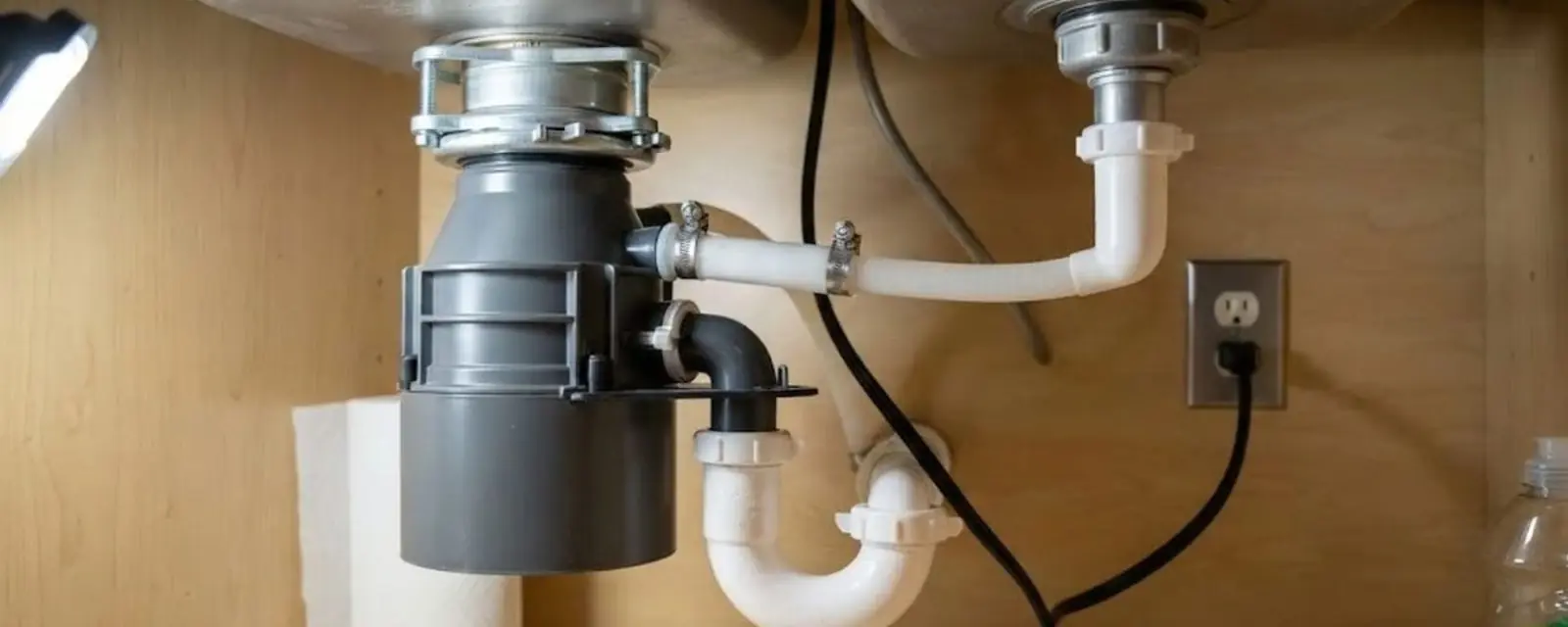
How a double sink drains
A double bowl sink has two drain openings. Each has a tailpiece that drops into a tee fitting. The tee joins the two flows and sends them to a single trap arm and trap. Without a disposal, the arrangement is simple. With a disposal, one bowl's drain becomes the disposal, and the other joins through a pipe.
The disposal mounts under one drain opening and has a discharge outlet on its side. A short tube connects that outlet to the tee. The second bowl's tailpiece connects to the tee as well. The result is that both bowls drain through the same trap, and the disposal sits below one of them.
Parts and tools
- Disposal with a mounting kit and a power cord or a hardwire option
- Disposal discharge tube and a new tee or continuous waste kit
- Plumber's putty and a dishwasher drain hose connection
- Screwdrivers, pliers, a basin wrench and a small hacksaw
- A bucket, rags and a flashlight
Measure the space under the sink first. Many cabinets are tight, especially with a filter, a soap dispenser or a water heater tucked in. A full-size disposal may not fit with a pull-out trash can. Tell the plumber about obstructions.
Installation steps
- Turn off the power at the breaker and close the shutoffs under the sink
- Remove the old drain flange and the trap pieces as needed
- Seat the new sink flange with plumber's putty and attach the mounting assembly
- Mount the disposal on the assembly and tighten it
- Remove the dishwasher knockout plug in the disposal inlet if a dishwasher will connect
- Connect the discharge tube to the tee and the trap, then the dishwasher hose
- Wire or plug in the unit, restore power and test with water running
The knockout plug is the most missed step. A dishwasher drain connects to a nipple on the side of the disposal, and the nipple has a plastic plug inside. If the plug stays in, the dishwasher cannot drain. Remove it with a screwdriver and a tap, and fish out the piece.
Rather not DIY the install?
Call (339) 216-9771 and a licensed plumber can handle it.
Dishwasher connection and the high loop
The dishwasher drain hose should loop high under the counter before connecting to the disposal. The high loop prevents dirty water from flowing back into the dishwasher. Secure it to the underside of the countertop. Some installations use an air gap on the sink deck instead.
Power, switch and safety
A disposal runs on a dedicated circuit in most kitchens. It can be plugged into an outlet under the sink, controlled by a wall switch, or hardwired. If no switch or outlet exists, a licensed electrician may need to add one. Never reach into the grinding chamber. Use tongs and turn off the breaker for any jam.
If the disposal you are replacing leaked or jammed, the garbage disposal repair page covers the common faults. And if your faucet is also old, a single visit can handle both, and faucet repair covers that side. Kitchens in the Medford service area and Arlington get the same service.
Troubleshooting after installation
- Leak at the sink flange: tighten the mounting ring and reseat the flange with fresh putty
- Leak at the discharge tube: check the gasket and tighten the connection
- Dishwasher will not drain: confirm the knockout plug is removed and the hose has a high loop
- Humming without grinding: free the flywheel with the hex wrench and press the reset button
- Breaker trips: check the wiring and call an electrician if it trips again
Run water for a minute with the disposal off, then watch each joint with a dry paper towel. A damp towel shows a slow leak that you can fix now. Then run the disposal with cold water and listen for rubbing or rattling.
If something is wrong and you cannot find it, the safest move is to stop and call a licensed plumber. A disposal sits next to wiring and a drain, and an error under the sink damages the cabinet quickly.
Choose the disposal to suit the household. A larger motor handles more food and runs more quietly, but it also costs more and needs more room under the sink. A continuous feed model is simple to use, while a batch feed model only runs with the stopper in place, which some families prefer around children.
Check the space before you buy, because a double sink with a deep basin and a dishwasher connection can be tight. Measure from the sink flange to the bottom of the cabinet and compare it with the height on the box. Save the manual and the receipt, since the warranty usually depends on both.
Winchester notes: older kitchens, permits and water
Kitchens in Winchester's older houses, from the mid 1800s homes near the center to the Wedgemere district built mostly between 1890 and 1920, were often remodeled in pieces. Under-sink space may hold an old trap arm, a wall-mounted drain stub in plaster and a limited electrical supply. A look under the sink before ordering tells you what you can fit.
State consumer guidance says replacing or relocating fixtures requires a permit from the local plumbing inspector, issued to licensed plumbers. Ask your plumber whether a disposal swap needs one in Winchester, and see the Building Department's page for the plumbing and gas inspector's contact details. Permit rules vary, so confirm with the town.
We found no hardness figure for Winchester in the MWRA community report. Water quality does not stop a disposal from working, but hard water leaves scale on faucets and fixtures. Test your tap and ask the Winchester Water Department for its latest report.
Disposal on a Double Sink: local questions
Yes, that is how it is usually done. The second bowl drains through the same tee and trap.
The knockout plug on the disposal inlet was probably left in. Remove it and clear the pieces.
One-third horsepower handles light use. A half to three-quarters horsepower suits a busy kitchen.
If there is no outlet or switch for the disposal, yes. A plumber can handle the plumbing side.